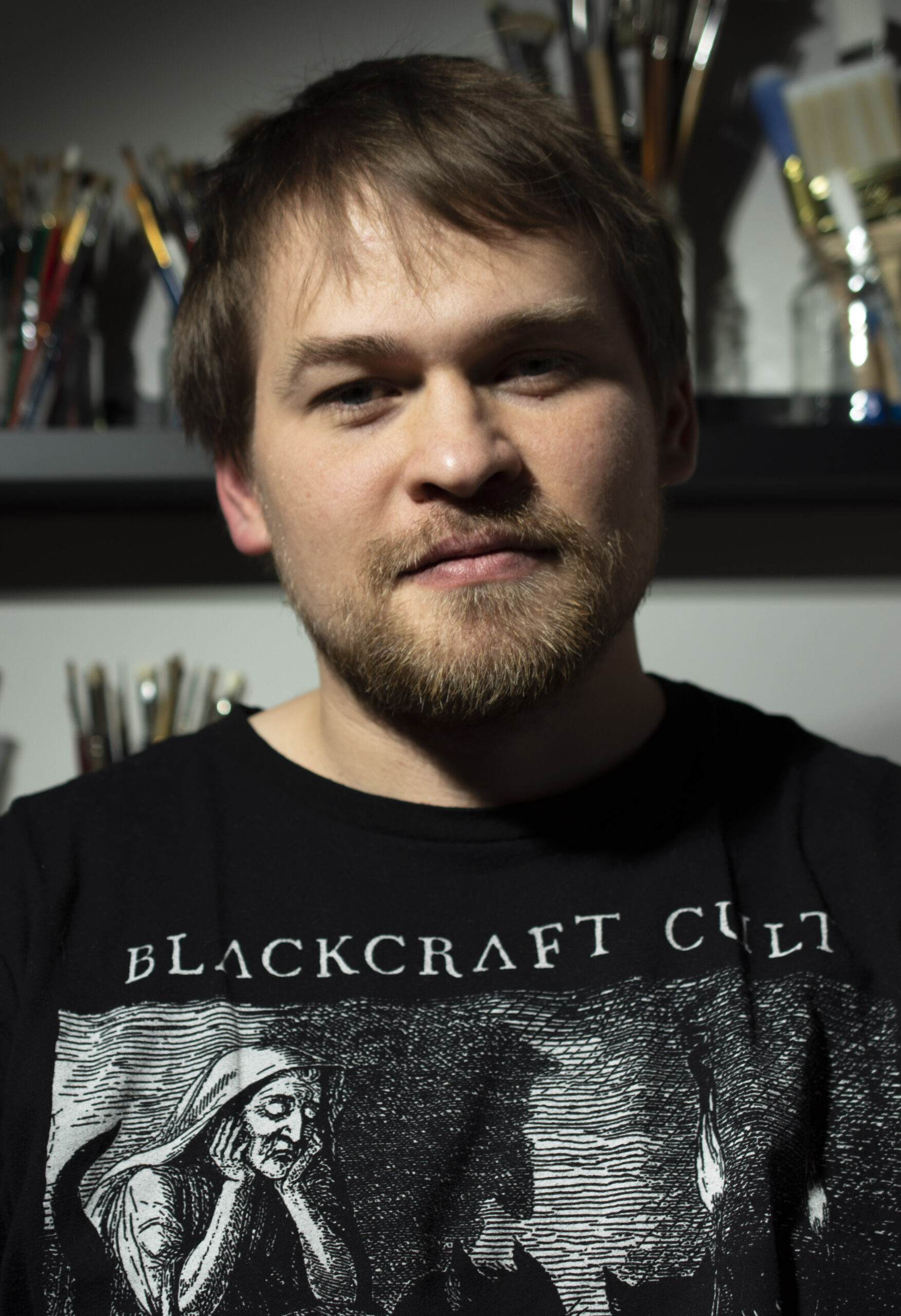
Mateusz LisiewiczŚwiat przeobrażony
W malarstwie Mateusza Lisiewicza rzeczywistość nigdy nie jest tym, czym wydaje się na pierwszy rzut oka. Rozpoznajemy w niej ludzkie ciało, zwierzęta, drzewa, krajobraz, gesty i przedmioty, a jednak zestawione ze sobą elementy szybko tracą swoje oczywiste znaczenia. W ich miejsce pojawia się świat rządzący się własnymi prawami — zamieszkany przez ludzi, demony, zwierzęta i istoty, których natury nie sposób jednoznacznie określić. To rzeczywistość dziwna, niepokojąca, ale zarazem zaskakująco spójna. Jakby istniała od zawsze, poza naszym doświadczeniem, a obrazy Lisiewicza pozwalały nam jedynie na chwilę uchylić do niej drzwi.
Artysta nie ilustruje jednak żadnej istniejącej mitologii. Przeciwnie — tworzy własny system obrazów, symboli i postaci, którego znaczenia pozostają częściowo ukryte. Pojawiające się w tych pracach ryby, ptaki, węże, hybrydy, demoniczne stworzenia czy tajemnicze artefakty przywołują skojarzenia z dawnymi wyobrażeniami religijnymi i magicznymi, lecz nie dają się przypisać do konkretnej opowieści. Można odnieść wrażenie, że oglądamy fragmenty mitu, którego nie znamy, albo obrzędu, którego sens został przed nami zatarty. Ta niedookreśloność jest jedną z największych sił tego malarstwa. Lisiewicz nie tłumaczy swojego świata — pozwala mu istnieć.
Lisiewicz nie tłumaczy swojego świata — pozwala mu istnieć.
Jego obrazy wyrastają z intuicji, ale intuicja ta nie oznacza przypadku. Za swobodą wyobraźni stoi konsekwentnie rozwijany warsztat i wieloletnie studium malarstwa. Lisiewicz świadomie pozostaje w dialogu z tradycją — od dawnych mistrzów niderlandzkich i renesansu, przez symbolizm i malarstwo XIX wieku, aż po współczesnych twórców figuracji. W jego pracach można odnaleźć echa Boscha, Böcklina, Moreau czy Waterhouse’a, ale także fascynację malarstwem Odda Nerdruma i współczesnymi formami figuracji fantastycznej. Nie chodzi przy tym o cytat ani o rekonstrukcję dawnych stylów. Historia sztuki staje się dla artysty raczej ogromną biblioteką obrazów, z której wybiera elementy i przekształca je zgodnie z własną wyobraźnią.
Właśnie owo „przeobrażenie” wydaje się kluczowe dla jego malarstwa. Znane formy zostają poddane nieustannej transformacji: ludzkie ciało staje się miejscem ingerencji innych stworzeń, zwierzę może stać się towarzyszem, ozdobą lub niemal sakralnym atrybutem, a postać demoniczna nie musi oznaczać zła. Granice pomiędzy tym, co ludzkie i nie-ludzkie, piękne i groteskowe, cielesne i nadprzyrodzone, zostają zawieszone. To świat, w którym hierarchie znane z naszej rzeczywistości przestają obowiązywać.
Istotną rolę odgrywa przy tym sama cielesność. Nagie postacie Lisiewicza nie są przede wszystkim figurami erotycznymi. Ich nagość ma charakter bardziej pierwotny — oznacza przynależność do świata, w którym ciało nie zostało jeszcze obciążone społecznym wstydem i konwencją. Ciało można ozdabiać, przekształcać, łączyć z innymi formami życia. Może stać się nośnikiem symbolu, talizmanem albo miejscem spotkania tego, co ludzkie, ze światem wyobrażonych stworzeń. W tym sensie cielesność u Lisiewicza jest jednym z języków jego osobnej mitologii.
Jednocześnie jest w tych obrazach coś, co wymyka się czysto narracyjnej interpretacji. Ich atmosfera ma charakter niemal religijny, choć nie odwołuje się do żadnego konkretnego wyznania. To raczej poczucie obecności czegoś niewidzialnego — tajemnicy, która poprzedza znaczenie i nie daje się do końca nazwać. Dlatego sceny przedstawiane przez artystę często przypominają obrzędy, spotkania, procesje czy inicjacje, ale nie wiemy, co właściwie się w nich wydarza. Możemy jedynie próbować odczytać gesty, relacje pomiędzy postaciami i pojawiające się symbole.
Lisiewicz świadomie wybiera drogę trudniejszą od tej, którą wyznacza współczesna kultura obrazu. Nie chce podporządkowywać malarstwa aktualnym trendom ani projektować go pod natychmiastową reakcję odbiorcy. Zamiast tego wraca do czegoś bardziej podstawowego: do potrzeby wymyślania obrazów, których wcześniej nie było. W tym sensie jego twórczość ma w sobie coś z dziecięcej wyobraźni, ale nie jest naiwna. Przeciwnie — dziecięca swoboda zostaje tutaj połączona z bardzo świadomym warsztatem i znajomością historii malarstwa.
Świat przeobrażony jest więc nie tyle opowieścią o innym świecie, ile próbą jego powołania. Lisiewicz nie przedstawia rzeczywistości, którą można rozpoznać i nazwać. Buduje własną — fragmentaryczną, pełną zagadek i istot o niejasnym pochodzeniu. Być może właśnie dlatego jego obrazy pozostawiają wrażenie obcowania z czymś jednocześnie znajomym i całkowicie nowym. Rozpoznajemy w nich język dawnego malarstwa, ale wypowiedziane nim historie nie należą już do przeszłości. Powstaje współczesna mitologia, której znaczenia nie zostały jeszcze ustalone.
Dominik Zieliński
kurator
Mateusz LisiewiczA World Reimagined
In Mateusz Lisiewicz’s painting, reality is never quite what it first appears to be. We recognise the human body, animals, trees, landscapes, gestures and objects, yet once brought together, these familiar elements gradually lose their conventional meanings. In their place emerges a world governed by its own laws — inhabited by humans, demons, animals and beings whose nature resists any clear definition. It is a strange and unsettling reality, yet one that possesses an extraordinary internal coherence. As though it had always existed beyond the limits of our experience, Lisiewicz’s paintings offer us only a fleeting glimpse into it.
The artist does not, however, illustrate any existing mythology. On the contrary, he constructs a personal system of images, symbols and figures whose meanings remain deliberately concealed. The fish, birds, snakes, hybrid creatures, demonic beings and enigmatic artefacts that populate his paintings evoke associations with ancient religious and magical imagery, yet cannot be assigned to any particular narrative. We may feel that we are looking at fragments of a myth we do not know, or at a ritual whose meaning has been obscured from us. This ambiguity is one of the defining strengths of Lisiewicz’s painting. He does not explain his world — he allows it to exist.
He does not explain his world — he allows it to exist.
His paintings emerge from intuition, but this intuition is anything but arbitrary. Beneath the freedom of his imagination lies a rigorous, sustained engagement with the practice and history of painting. Lisiewicz consciously enters into dialogue with the tradition — from the Old Masters of Northern Europe and the Renaissance, through Symbolism and nineteenth-century painting, to contemporary figurative artists. Echoes of Bosch, Böcklin, Moreau and Waterhouse can be sensed in his work, alongside an affinity with the painting of Odd Nerdrum and contemporary forms of fantastic figuration. Yet this is not a matter of quotation or stylistic reconstruction. The history of art functions instead as an immense visual library, from which the artist draws and transforms elements according to the logic of his own imagination.
It is precisely this act of transformation that seems fundamental to his painting. Familiar forms are continually subjected to metamorphosis: the human body becomes a site of intervention by other creatures; an animal may become a companion, an ornament, or something approaching a sacred attribute; a demonic figure need not embody evil. The boundaries between human and non-human, beautiful and grotesque, corporeal and supernatural are suspended. This is a world in which the hierarchies familiar to us no longer apply.
The body itself occupies a particularly important place within this universe. The nude figures in Lisiewicz’s paintings are not primarily erotic. Their nakedness is more elemental — it suggests belonging to a world in which the body has not yet been burdened by social conventions of shame and propriety. The body may be adorned, transformed, or fused with other forms of life. It can become a bearer of symbols, a talisman, or a site of encounter between the human and the imagined realms of other creatures. In this sense, corporeality becomes one of the languages through which Lisiewicz constructs his private mythology.
At the same time, there is something in these paintings that resists purely narrative interpretation. Their atmosphere is almost religious, although it belongs to no particular faith or established system of belief. Rather, it evokes a sense of an unseen presence — a mystery that precedes meaning and cannot be fully articulated. This is why Lisiewicz’s scenes often resemble rites, processions, encounters or initiations, while the nature of what is actually taking place remains unknown. We can only attempt to read the gestures, the relationships between the figures and the symbols that emerge within the compositions.
Lisiewicz consciously chooses a path more difficult than the one prescribed by contemporary image culture. He does not seek to subordinate painting to prevailing trends or to construct it around the immediate response of the viewer. Instead, he returns to something more fundamental: the impulse to imagine images that did not previously exist. In this respect, his work retains something of the freedom of a child’s imagination, yet it is far from naïve. On the contrary, that imaginative freedom is coupled with a highly developed technique and a profound awareness of the history of painting.
A World Reimagined is therefore not so much a story about another world as an attempt to bring one into being. Lisiewicz does not depict a reality that can simply be recognised and named. He constructs his own — fragmentary, enigmatic, and inhabited by beings of uncertain origin. Perhaps this is precisely why his paintings create the sensation of encountering something at once familiar and entirely new. We recognise in them the language of historical painting, yet the stories spoken through that language no longer belong to the past. What emerges is a contemporary mythology whose meanings have yet to be determined.
Dominik Zieliński
curator